Table of contents
- Format is not a stylistic choice, but a strategic decision
- Four common corporate communication scenarios
- Which format fits which objective?
- Live audience: when it adds value — and when it doesn’t
- Formats as an extension of governance
- Studio and format are inseparably linked
- Translating strategy into practice
- Frequently asked questions about live formats
Format is not a stylistic choice, but a strategic decision
In live communication, it’s not only about what an organisation communicates, but also how that message is delivered. Especially in a corporate context, the chosen format largely determines how a message is interpreted by employees, stakeholders and external audiences.
Live communication can reinforce authority, build trust or drive engagement, but only when the format is chosen deliberately. An ill-suited format can create uncertainty, distract from the message or undermine an organisation’s credibility.
This article helps organisations make that choice. Not from a technical perspective or personal preference, but based on communication objectives, context and controllability. Live formats are therefore approached as strategic instruments, not as standalone productions.
The choice of a live format is never independent of the studio environment in which it is executed.
Four common corporate communication scenarios
Within corporate live communication, several scenarios recur consistently. Each scenario requires its own balance between authority, interaction and reach.
Leadership updates & internal town halls
- Objective: clarity, trust and consistency
- Need: calm, control and a clear hierarchy
Strategic or financial announcements
- Objective: credibility and careful framing
- Need: direction, timing and context
Panel discussions & expert conversations
- Objective: dialogue, depth and engagement
- Need: interaction without losing structure
Stakeholder and partner communication
- Objective: combining reach with exclusivity
- Need: a hybrid format with clear direction
Which format fits which objective?
Newsroom / desk setup
This format is particularly well suited for communication where authority and clarity are central, such as board updates, executive addresses or formal announcements.
The setting supports a calm, professional presence and helps speakers deliver their message in a controlled and structured manner.
Talk show or table setting
When dialogue and engagement are more important than hierarchy, a talk show or table setting offers greater room for interaction. This format is often used for internal conversations, expert panels or in-depth sessions.
Auditorium & live audience
For moments that require weight and visibility, the auditorium provides an appropriate stage. A live audience can amplify energy and urgency provided it is carefully directed.
This format demands experience and preparation, but can significantly enhance impact and audience experience.
The key challenge is balance: enough dynamism without losing control or focus.
Hybrid formats: studio + online reach
Increasingly, organisations opt for hybrid setups, where speakers and audiences participate both on-site and online. This combines scale with control, provided the studio, technology and platform are integrated end-to-end.
Within Studio Zandkasteel, this can be seamlessly combined with the VIXY webinar platform, ensuring registration, interaction and reporting remain part of a single direction environment.
Live audience: when it adds value — and when it doesn’t
The presence of a live audience influences speakers, pacing and tone. In some communication moments, it strengthens the message; in others, it can distract or increase risk.
Making a deliberate decision upfront prevents form from overshadowing content.

Formats as an extension of governance
As outlined in “The professional standard for corporate live communication“, formats are not aesthetic choices, but part of governance and reputation management. By treating format selection as a strategic instrument, organisations retain control over interpretation, timing and impact.
Studio and format are inseparably linked
Studio Zandkasteel supports organisations in making these choices. Not by imposing standard formats, but by jointly determining which format best serves the communication objective — in terms of content, technology and organisation.

Translating strategy into practice
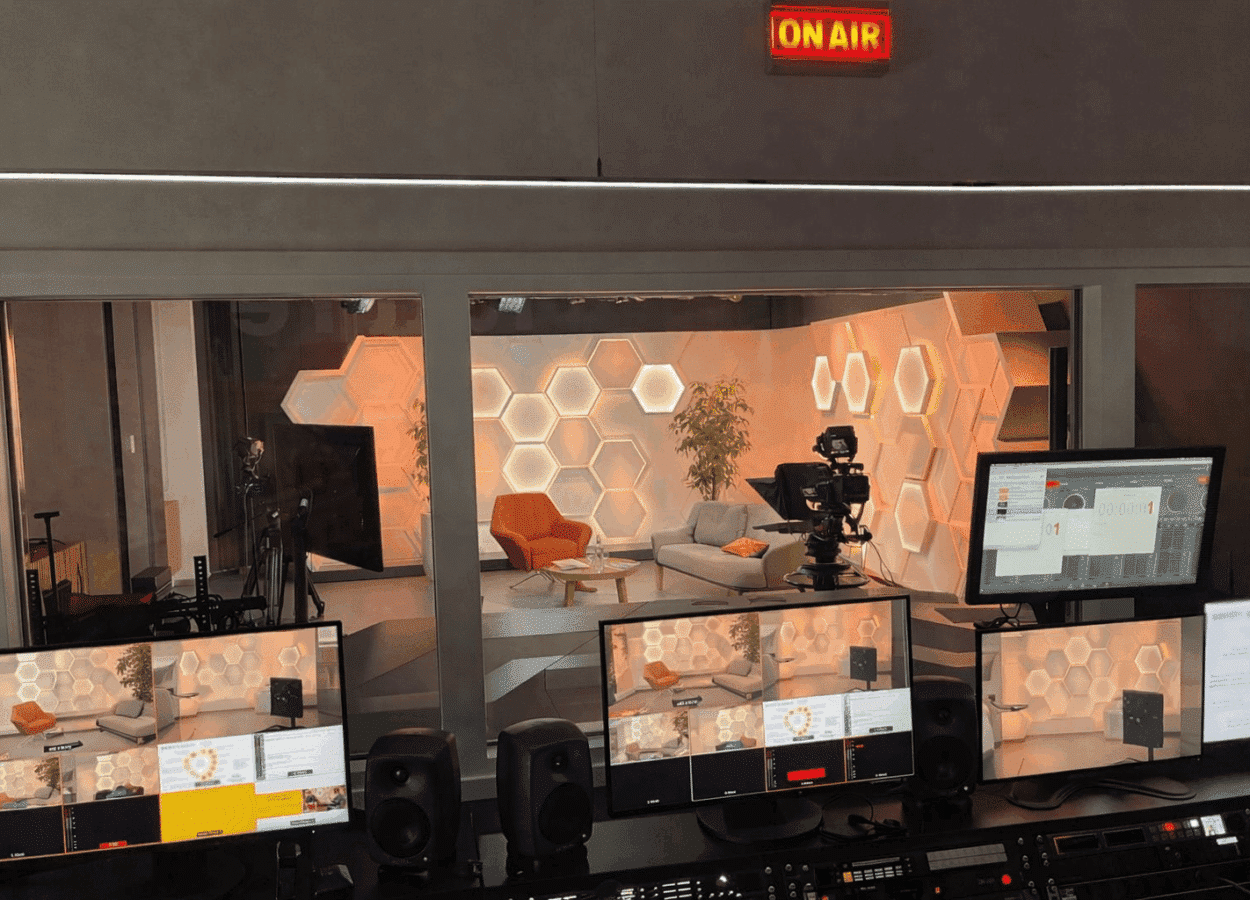
The right format only truly delivers value within a permanent, professionally designed studio environment. At Studio Zandkasteel in Amsterdam, these formats are supported by fixed direction, high-end technology and an environment that provides calm and focus for speakers and organisations alike.
By executing formats within a permanent studio, organisations maintain control over look & feel, process and quality — whether for an internal town hall, a strategic announcement or a hybrid event with online reach.
Read more about the possibilities of Studio Zandkasteel as the core of a live communication programme.

Frequently asked questions about live formats
Which live format works best for corporate communication?
That depends on the objective. For authority and clarity, a newsroom or desk format is most suitable, while talk show and panel formats work better for dialogue and engagement. Hybrid formats combine reach with control.
When should you choose a hybrid event?
Hybrid events are suitable when organisations want to achieve both live impact and scalable online reach, without compromising on direction and quality.
What is the difference between a webinar and a live studio broadcast?
A live studio broadcast offers greater control over look, direction and production. Combined with a professional webinar platform, it creates a scalable and interactive solution.
Can one studio support multiple formats?
Yes. A permanent, professionally equipped studio such as Studio Zandkasteel is designed to facilitate multiple formats within one consistent direction environment.